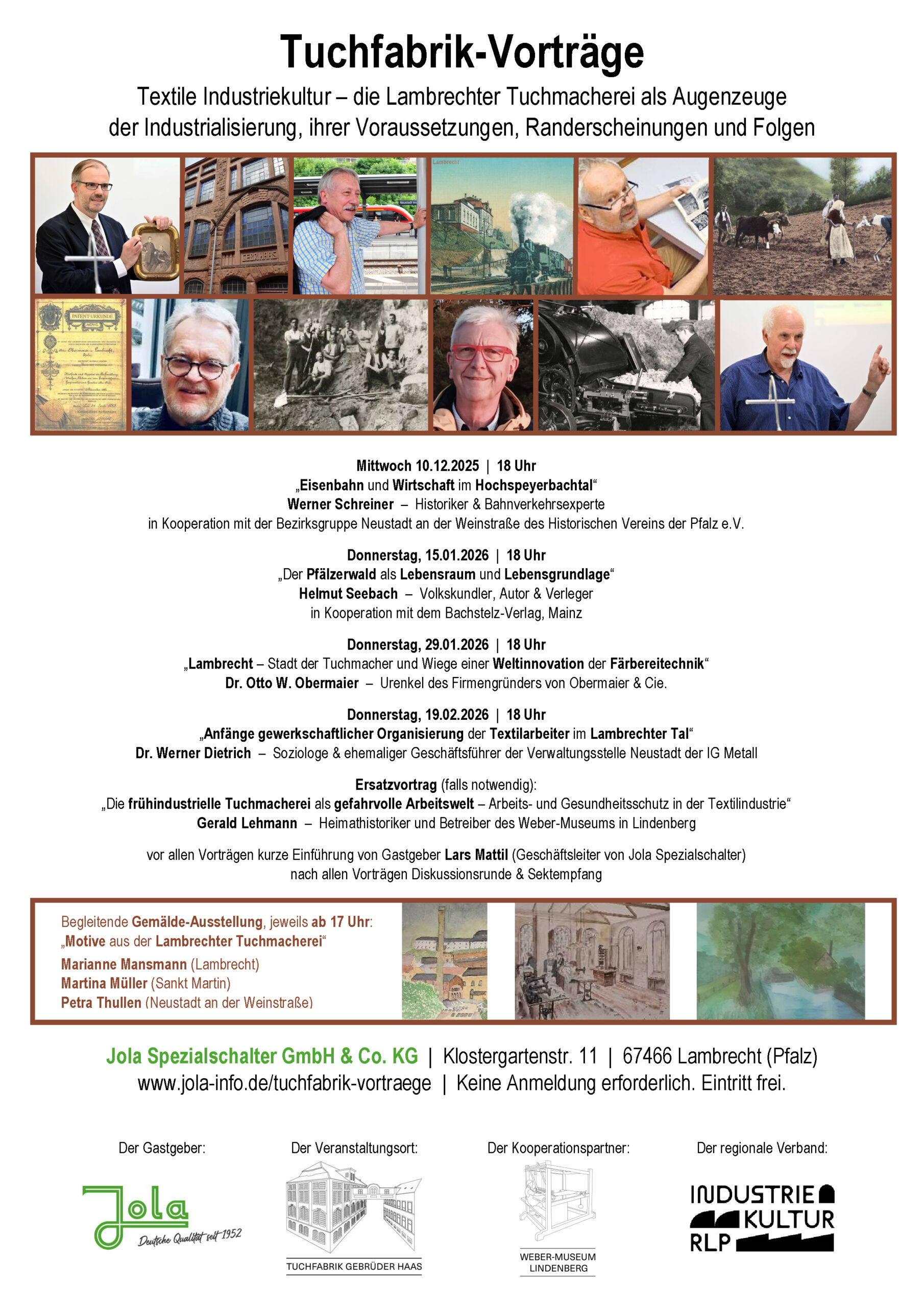
Cloth Factory Lectures 2025/2026 at Jola Spezialschalter in Lambrecht
On 10 December 2025, the starting signal will be given for a series of events in the former cloth factory Gebrüder Haas (today Jola Spezialschalter): Textile Industry Culture – Cloth Manufacturing in Lambrecht as an Eyewitness to Industrialisation, its Prerequisites, Side Effects and Consequences.
In the mid-16th century, Wallonian religious refugees were allowed to settle in the abandoned St. Lambrecht Monastery. They brought their craft – cloth making – with them and helped the small town achieve an enormous economic boom. Over the centuries, despite many ups and downs, a lively working-class town developed, and industrialisation led to the emergence of mechanical spinning mills and eventually full cloth factories, combining all stages of production from the processing of the raw wool through the spinning process to the finished cloth. This earned Lambrecht the nickname “clothmaker’s city” until they stopped production in the 1960s in the wake of the economic decline of the German textile industry due to market changes.
In one such location – the former Gebrüder Haas cloth factory – a series of events entitled “Tuchfabrik-Vorträge” (Cloth Factory Lectures) will begin in December 2025 and run until February 2026, dealing with various topics related to local cloth manufacturing. The subtitle is: “Textile Industry Culture – Cloth Manufacturing in Lambrecht as an Eyewitness to Industrialisation, its Prerequisites, Side Effects and Consequences”. It has been deliberately chosen to be broad in order to allow for a wide variety of topics. The speakers are specialists in their respective fields and most of them have already made a name for themselves through research, publications and/or lectures. They will focus on specific topics, which will then be woven together over time like threads to form a complex cloth.
The lecture series is a collaboration between Jola Spezialschalter, the Weaver Museum Lindenberg and, in some cases, other partners. Under the motto “The future needs history, progress needs tradition”, the aim is to create opportunities for people to learn from the past in order to better understand the present and shape innovation.
This approach also fits perfectly with the time-honoured motto that has adorned the wall of the management office for many decades: “To create and to strive / is our imperative, / progress is life, / stagnation is death !” It is about innovative spirit and progress based on what has already been achieved. Jola Spezialschalter is living proof that it is possible to create something new and look to the future with optimism and enthusiasm, despite enormous problems.
The dates:
- Wednesday, 10 December 2025 | 6 p.m.
“Railways and the Economy in the Hochspeyerbach Valley”
Werner Schreiner – historian and rail transport expert
in cooperation with the Neustadt an der Weinstraße district group of the Historical Association of the Palatinate - Thursday, 15 January 2026 | 6 p.m.
“The Palatinate Forest as a Habitat and Basis of Life”
Helmut Seebach – folklorist, author and publisher
in cooperation with Bachstelz-Verlag, Mainz - Thursday, 29 January 2026 | 6 p.m.
“Lambrecht – Town of Cloth Makers and Cradle of a World Innovation in Dyeing Technology”
Otto W. Obermaier – great-grandson of the founder of Obermaier & Cie - Thursday, 19 February 2026 | 6 p.m.
“The Beginnings of Trade Union Organisation among Textile Workers in the Lambrecht Valley”
Werner Dietrich – sociologist & former managing director of the Neustadt administrative office of IG Metall - Alternative lecture (if necessary):
“Early Industrial Cloth Making as a Dangerous Working Environment – Occupational Health and Safety in the Textile Industry”
Gerald Lehmann – local historian and operator of the Weaver Museum in Lindenberg
All lectures will begin at 6 p.m. They will be followed by a discussion and a small champagne reception.
There will also be an accompanying painting exhibition, which can be viewed before and after the lectures on the respective lecture dates from 5 p.m. onwards. The painters Marianne Mansmann (from Lambrecht), Martina Müller (from St. Martin) and Petra Thullen (from Neustadt an der Weinstraße) have exhibited their works together on several occasions. They have compiled “Motifs of the Lambrecht Cloth Fabrication” especially for the cloth factory lectures. The exhibition features watercolours, watercolours with ink, acrylics and cyanotypes.
The series of events is part of the ongoing efforts of the Industriekultur RLP association, founded in 2024, to make the history of industry and craftsmanship in Rhineland-Palatinate visible and tangible as an association of various cultural initiatives.
Registration is not required. Admission is free.
More information here: